

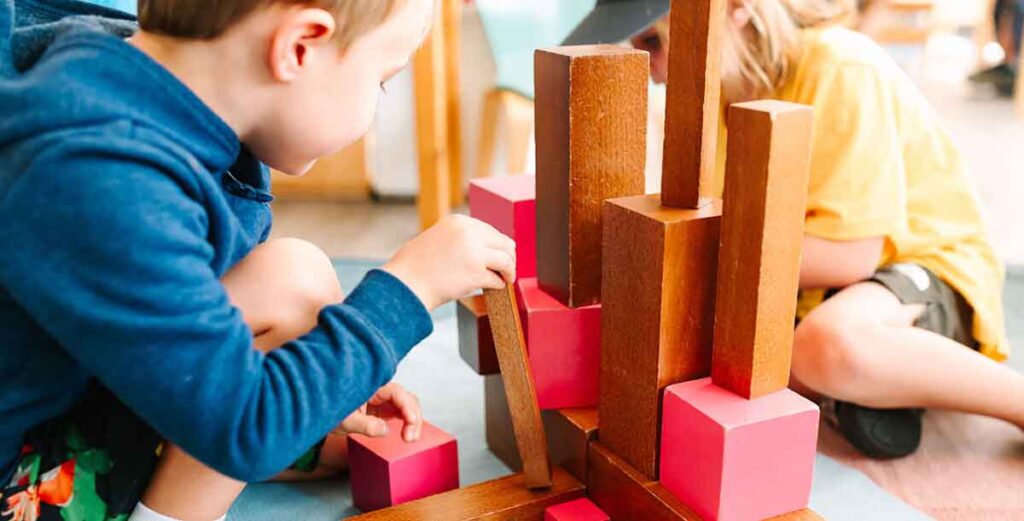
A Love of Learning That Is Protected, Not Produced
There is a quiet assumption many adults carry, often without realizing it: that children must be motivated to learn. That curiosity is something to be kindled from the outside, that engagement requires incentive, that the desire to understand the world is a quality some children happen to have and others need to be given.
In Montessori, we begin from a different premise entirely.
The desire to learn is not something that must be introduced or engineered. It is already present. Watch a young child closely and you will see it everywhere: the repetition of a movement practiced until it is mastered, the careful attention brought to a task no adult assigned, the insistence on doing something independently that is both fiercer and more focused than anything a reward system could produce, the steady return to a problem until it yields. This is not random behavior. This is true curiosity, a deep and persistent drive to understand the world and one’s place within it, and it belongs to every child.
Dr. Montessori saw this drive not as something education creates but as something education can either protect or extinguish. “The child is both a hope and a promise for mankind,” she wrote, and she meant it precisely: the child arrives already oriented toward growth, already hungry to learn, already in possession of everything that matters most. The task of education is not to produce this orientation but to honor it, to build an environment worthy of it, and to trust it enough to let it lead.
At Sunny Hollow, we see our role not as creating a love of learning but as protecting one that is already there. Through an authentic Montessori education that begins at 16 months and continues through 8th grade, we offer children an environment in which this natural inclination can unfold, deepen, and endure across the whole of their childhood.
What Makes Montessori Authentic, and Why It Matters
The word authentic carries weight, and it is worth being direct about what it means and why we use it.
Montessori is not a trademarked term. Any school can use the name, and many do, with programs that range from deeply faithful to loosely inspired. A classroom with a few wooden materials and a choice time built into the afternoon is not the same as a fully realized Montessori program. The difference is not cosmetic. It is developmental, and it is consequential.
An authentic Montessori education is defined by a coherent set of principles, each precisely developed and each dependent on the others: a prepared environment designed around the child’s independence rather than the adult’s convenience; real, purposeful materials with built-in control of error; a trained guide whose primary skill is observation and whose primary discipline is restraint; a work cycle long enough to allow genuine concentration to develop; a mixed-age community organized around the developmental reality of children rather than the administrative convenience of institutions; and a philosophical commitment to the child’s natural drive toward growth that permeates every decision, from the height of the shelves to the length of the morning.
Sunny Hollow is the only school in Minneapolis offering this full program, authentically and completely, from 16 months through 8th grade. Not a Montessori-inspired approach. Not Montessori in the early years with a conventional transition later. The real thing, across the whole of childhood, in a single connected community that knows your child’s story from the beginning.
This matters because authenticity is not simply a point of philosophical pride. It is the condition under which the program actually works. Dr. Montessori designed each element of her methodology in relationship to every other element; remove or dilute one, and the others are diminished. The prepared environment without the work cycle cannot produce normalization. The work cycle without the trained guide cannot sustain independence. The materials without the mixed-age community lose the peer learning and mentorship that deepen their impact. Authentic Montessori is not a collection of features. It is an integrated whole, and it requires the whole to deliver what it promises.
An Education That Holds Together Across a Childhood
At Sunny Hollow, children experience Montessori as a continuous and coherent journey, from their first days in the toddler community through their final year of junior high. This continuity is not simply logistical. It is developmental, relational, and deeply intentional.
In many educational settings, children are asked to begin again, repeatedly, across their school years: new teacher, new classroom, new expectations, new definitions of what success looks like and how it is recognized. Each transition, however well-managed, asks the child to spend energy on adaptation that might otherwise go toward learning. The community that knew them is left behind. The adults who understood their particular way of working must be replaced by adults who are starting from scratch.
A fully realized Montessori education from toddler to middle school offers something different: a consistent philosophical and pedagogical foundation across every stage of growth, so that children move forward without losing their footing. The principles that organized the toddler environment are the same principles that organize the junior high. The language is familiar. The expectations, while expanding in complexity, are grounded in the same values. The community is continuous.
Within this consistency, children develop something that is difficult to build any other way: a deep and abiding trust, in their environment, in their guides, and in themselves. Because the structure is stable and the relationships are enduring, risk-taking becomes possible in a way it rarely is when children are perpetually new somewhere. They try. They make mistakes. They adjust and try again, not because they are required to demonstrate resilience but because the ground beneath them is solid enough to make the attempt feel safe.
This is the foundation on which everything else rests. Academic growth, social development, confidence, independence, the love of learning itself, all of these are most available to a child who feels genuinely known and genuinely secure. At Sunny Hollow, we build that security not through a single warm teacher or a single good year but through the sustained, cumulative experience of belonging to a community that has always known your name.
From First Steps to Adolescence, What Each Stage Offers
An authentic Montessori education is not defined by a single classroom or a single stage. It is defined by the way each phase builds upon the last, creating a cohesive arc of development that carries the child forward without ever asking them to start over.
- Toddler (16–36 months): The earliest Montessori years are organized around the body, the will, and the first stirrings of independence. Children are given the opportunity to move, to choose, and to complete real tasks from beginning to end, pouring water, caring for plants, dressing themselves, establishing an early and unshakeable sense of their own capability. Dr. Montessori called this “the construction of the self,” and she meant it literally: the toddler who successfully buttons their own coat is not completing a practical task. They are assembling, piece by piece, the person they are becoming.
- Casa (3–6 years): The Casa years are where the absorbent mind meets the prepared environment at its fullest expression, and where some of the most dramatic learning in the entire program occurs. Children engage with materials that make abstract concepts tangible: the sandpaper letters that connect touch and sound to build early literacy, the golden beads that give concrete form to the decimal system, the cylinder blocks that develop the visual discrimination and fine motor precision that underlie all future academic work. Concentration deepens. Independence expands. And children who have been trusted with real work and real choice begin, in these years, to understand themselves as genuinely capable learners.
- Elementary (6–12 years): Students move into a period of intellectual expansion and social engagement, asking big questions, making connections across disciplines, and beginning to understand their place within the broader human story. The Great Lessons of Cosmic Education open the universe to them, literally, from the formation of galaxies to the development of human civilization, and the Montessori work cycle gives them the uninterrupted time to follow their genuine curiosity wherever it leads. Collaboration becomes central, as does the capacity for critical thinking, long-term project management, and the kind of sustained intellectual engagement that most students do not encounter until much later.
- Junior High (7th–8th grade): All the threads come together. The curiosity cultivated in Casa, the collaborative habits of Lower Elementary, the intellectual independence of Upper Elementary, all of it converges in these two years into something that begins to look like a fully realized person. Students apply their learning in meaningful, real-world contexts, take on genuine responsibility, engage in complex problem-solving, and reflect seriously on their values and their role within a community that extends beyond the classroom. They leave Sunny Hollow not just academically prepared but genuinely ready, for high school, for the world, and for a lifetime of learning that will not require anyone to push them.
Frequently Asked Question:
What Is the Difference Between Authentic Montessori and Regular Montessori?
Authentic Montessori refers to programs that fully implement Dr. Montessori’s methodology across all its interconnected elements: the prepared environment, AMI or AMS-trained guides, the complete sequence of Montessori materials, multi-age classrooms organized in three-year cycles, and an uninterrupted work cycle of two to three hours. Because “Montessori” is not a protected term, schools vary widely in how faithfully they implement these principles. A partial implementation, Montessori materials without the work cycle, or Montessori in the early years without continuation through elementary and middle school, produces a different and more limited experience than a fully realized program. Sunny Hollow offers complete, authentic Montessori from 16 months through 8th grade, the only program of its kind in Minneapolis.
Who Your Child Becomes
A Sunny Hollow graduate is academically prepared, not simply for the next step but for a lifetime of genuine learning. They are autonomous and independent, capable of leading themselves through complexity and uncertainty. They are confident and competent, grounded in real experience rather than in reassurance. They are intrinsically motivated, driven by curiosity rather than by reward. They are socially responsible, showing up for others with consistency and care. They are global citizens, ready to advocate for people and planet with both conviction and humility. And they are connected to something larger than themselves, carrying a sense of meaning and wonder that no classroom can fully contain.
Most importantly, they retain what is so often lost across years of conventional schooling: a love of learning. Not because they were told to love it. Not because they were rewarded for performing it. But because they experienced it, every day across their entire childhood, as something purposeful, meaningful, and deeply their own.
That love was there when they arrived. We simply made sure it was still there when they left.
There is no substitute for seeing it in person. Prospective families are warmly and always welcomed to observe our classrooms at any level. Sunny Hollow is the only authentic Montessori program in Minneapolis serving children from 16 months through 8th grade. Choose a time here. Current families, use the scheduling link provided by your guide.
Schedule a tour