

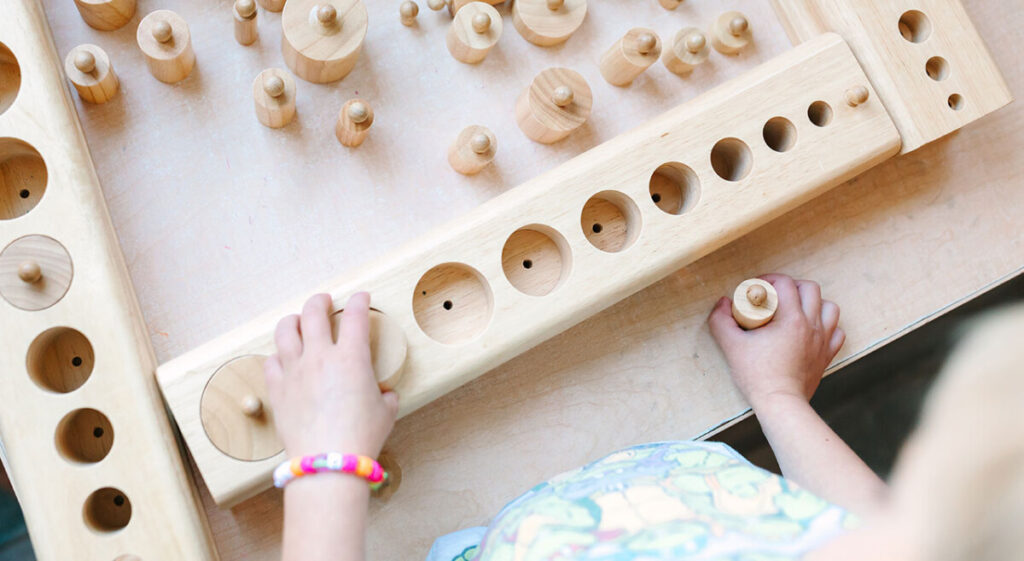
Hands-on learning that’s low-tech, high-impact—and built for real children (wiggles included)
Walk into a Montessori classroom and you feel it before you understand it.
It’s calm, but not quiet.
Ordered, but not rigid.
Alive with movement, but never chaotic.
Children are engaged, moving with purpose, and working independently or in small groups with a quality of attention that stops most first-time visitors in the doorway.
This is not incidental, and it is not luck. It is the result of a classroom that has been designed, in every detail, around the developmental needs of the children within it. The materials on the shelves, the height of the furniture, the arrangement of the space, the absence of screens, the presence of real glass and real wood and real water, all of it has been chosen and placed with a precision that most visitors sense before they can name.
What you are feeling is authentic Montessori. And it is worth understanding what makes it authentic, because not every school that carries the name delivers what the name promises.
Dr. Montessori was clear about what the prepared environment requires: “The environment must be rich in motives which lend interest to activity and invite the child to conduct her own experiences.” This is not a loose standard. It is an exacting one, and meeting it fully, across every classroom from toddlerhood through 8th grade, is one of the defining commitments of a Sunny Hollow education.
Real Materials. Real Purpose. Nothing Random.
In a genuinely prepared Montessori environment, nothing on the shelf is decorative, arbitrary, or interchangeable. Every material has been designed, tested across more than a century of use, and placed with a specific developmental purpose in mind. Each isolates a single quality for the child’s attention, invites repetition, and carries within itself the means for the child to discover their own errors without adult correction.
A few examples worth knowing by name, because parents who understand what these materials are doing tend to see the classroom very differently:
The Pink Tower, a set of ten wooden cubes decreasing precisely in size, is not a stacking toy. It develops visual discrimination, coordination, and an early, embodied understanding of dimension and mathematical relationship. The child who has spent months with the Pink Tower is not simply playing with blocks. They are constructing the perceptual and conceptual foundations that will make mathematics feel, years later, like recognition.
The Sandpaper Letters connect tactile movement with letter recognition, activating auditory, visual, and kinesthetic pathways simultaneously. A child who traces the letter s with her fingertip while hearing its sound is not being taught to read in the conventional sense. She is absorbing the connection between symbol, movement, and phoneme through multiple channels at once, during the sensitive period when that absorption is most effortless and most durable.
The Golden Bead Materials give concrete, physical form to the decimal system: units, tens, hundreds, and thousands, handled and combined and separated, so that when abstract numerical notation arrives later, it lands not as a foreign language but as a symbol for something the child already understands in their hands and in their body.
In Upper Elementary, the Checkerboard extends this concreteness into multi-digit multiplication, allowing students to work through problems of genuine complexity, including verification of their own answers, with a material that makes the mathematical structure visible and manipulable. The student who has multiplied four-digit numbers on the checkerboard and checked her work by reversing the operation has done something no worksheet can replicate: she has understood what multiplication actually is.
There is no busywork here. Every material on every shelf in every classroom, from the toddler community through junior high, has a clear developmental purpose and a precise place in the sequence. This is what authentic Montessori materials look like. And it is what parents should look for when they visit any school that uses the Montessori name.
Built for Independence and Curiosity (From the Ground Up)
Low-Tech by Design. High-Impact by Result.
Sunny Hollow is, for the bulk of a child’s years here, a screen-free learning environment. This is not a nostalgic position or a reaction against technology. It is a considered, developmental commitment grounded in more than a century of observation about how children actually learn.
Young children learn through direct physical engagement with the world. Real materials, glass that can break, water that can spill, wood with genuine weight and texture, offer resistance, consequence, and sensory information that a screen cannot replicate. They demand a quality of attention that a touchscreen does not. They build, through repeated hands-on use, the neurological and physical foundations that underlie reading, writing, mathematical thinking, and sustained concentration.
Dr. Montessori observed that the child’s hand is not simply a tool for executing what the mind has already decided. It is, in the early years especially, a primary organ of intelligence. “The hand is the instrument of the mind,” she wrote. “The child’s intelligence can develop to a certain level without the help of his hand. But if it develops with his hand, then the level it reaches is higher, and the child’s character is stronger.” A child whose early years are spent with their hands in purposeful, real, physical work develops something that no amount of screen time can provide: a genuine relationship with sustained effort, with the satisfaction of making something real happen in the physical world.
This is why Sunny Hollow students spend their early and middle years with golden beads and sandpaper letters and real pitchers of water rather than with educational apps, however well-designed those apps might be. The hands-on work comes first, not because we are skeptical of technology but because we understand the sequence. Concrete before abstract. Real before virtual. Hands before screens.
As students move into Upper Elementary and Junior High, technology earns its place, thoughtfully and purposefully, for word processing, research, and the production of meaningful work. Students who arrive at these tools having already developed genuine focus, critical thinking, and the capacity for sustained independent work use technology differently than students for whom it has always been the default. They use it as a tool, not as a teacher. That distinction, built across years of screen-free, hands-on engagement, is one of the most consequential things a Sunny Hollow education produces.
Our goal is not to shelter students from the digital world; it’s to prepare them to meet it with discernment, confidence, and balance. They know how to focus without distraction, communicate with compassion, and think critically about what they see.
In a world that often rushes children toward screens before they’re developmentally ready, Sunny Hollow offers something rare: the gift of growing up human first.
Movement Is an Essential Part of Learning
In most classrooms, movement is managed: permitted at certain times, in certain amounts, for certain purposes, and restricted the rest of the time. The underlying assumption is that learning happens when children are still, and movement is something to be contained so that learning can occur.
Montessori classrooms begin from a different understanding entirely.
In an authentic Montessori environment, movement is not a break from learning. It is one of its primary vehicles. Children move freely within the classroom, choosing their workspace, carrying materials from shelf to workspace and back, working on the floor, at tables, and, when appropriate, outdoors. This movement is purposeful and supported by clear expectations, but it is not restricted, because restriction would undermine one of the most important developmental commitments the classroom makes.
Dr. Montessori was direct about the relationship between movement and cognition: “Movement, or physical activity, is thus an essential factor in intellectual growth, which depends upon the impressions received from outside. Through movement we come in contact with external reality, and it is through these contacts that we eventually acquire even abstract ideas.” The child who carries a tray of materials across the room is not simply transporting objects. They are developing coordination, spatial awareness, and the physical self-regulation that will later support their capacity for sustained intellectual work. The child who chooses to work on the floor rather than at a table is not avoiding structure. They are managing their own sensory and physical needs in exactly the way the environment has been designed to allow.
Research in developmental neuroscience has consistently supported what Montessori observed more than a century ago: movement supports concentration and sustained attention, strengthens coordination and executive functioning, and contributes meaningfully to emotional regulation. Students for whom movement is a genuine regulatory need find themselves, in a Montessori classroom, in an environment that does not pathologize that need but meets it. They are not asked to sit still and attend. They are trusted to manage their own bodies in the service of their own learning.
What visitors consistently observe, and what our guides confirm, is that when children are genuinely trusted with this freedom, they tend to move with greater care and intention, not less. The room is active and calm at the same time, because the movement is purposeful rather than restless, directed by the child’s own genuine engagement rather than released in bursts between periods of enforced stillness.
This is not a feature of every school that uses the Montessori name. It is a feature of an authentic Montessori environment, one that has been prepared not just philosophically but physically, with the open floor space, the accessible shelving, the appropriately sized furniture, and the established community expectations that make genuine freedom of movement possible and productive.
What This Means for Your Child
An authentic Montessori classroom, fully and faithfully realized across every level of the program, gives your child something that a partial or approximate version cannot: the complete experience of an environment designed, in every detail, around who they actually are and what they actually need.
Over the course of their years at Sunny Hollow, your child will:
- Work with real, purposeful materials that have been designed and refined across more than a century of use, each serving a precise developmental purpose and each worthy of the serious attention children bring to them
- Develop genuine focus and concentration through hands-on, screen-free engagement that builds the neurological and physical foundations for sustained intellectual work long before abstract learning arrives
- Move freely and purposefully within an environment that understands movement as a vehicle for learning rather than an obstacle to it, developing the physical self-regulation and coordination that support everything else
- Build a relationship with real things, with weight and texture and consequence, that no screen-based experience can replicate and that forms the foundation for genuine understanding of the abstract concepts that follow
- Experience the full developmental arc of an authentic Montessori education, from toddlerhood through 8th grade, in a program that does not approximate the philosophy but realizes it completely
Sunny Hollow is the only authentic Montessori school in the Cities, serving children from 16 months through 8th grade with a program that is fully realized at every level. When you walk through our doors, what you feel before you understand it is the result of that commitment, present in every material on every shelf, in every choice about technology and movement and the design of the space, and in every child who is, right now, exactly where they need to be.
This isn’t loose or unstructured. It is thoughtfully engineered for learning.