

Portrait of a Graduate, Part Two
This series of blogs explores our new Portrait of a Graduate, seven traits that describe who a Sunny Hollow education prepares your child to become, from our youngest 16-month-olds through 8th grade.
We Are Raising Leaders
There is a kind of student who knows exactly what the teacher wants and delivers it reliably. They follow instructions, meet expectations, and produce clean results. And then, when the instructions stop, they wait.
This is not a character flaw. It is, in many ways, the natural product of an education built around external direction. When children spend years learning to respond to prompts, they become very good at responding to prompts. What they sometimes don’t develop is the capacity to generate their own.
At Sunny Hollow, we are interested in something different. We want graduates who can make a decision, sit with a problem long enough to find their way through it, manage their responsibilities, and ask for help when they need it, because knowing when to ask is its own kind of strength.
This is what we mean by autonomous and independent. Not children who do everything alone, but children who trust their own minds and know how to use them.
What Does Independence Look Like in a Montessori Classroom?
Dr. Montessori observed that children have a deep and persistent drive to do things for themselves. She called it the child’s cry: “Help me to do it alone.” This impulse, visible in every toddler who insists on putting on their own shoes, is not stubbornness. It is the developmental expression of a child who is ready to grow.
Montessori independence is built by honoring that impulse, consistently and across years.
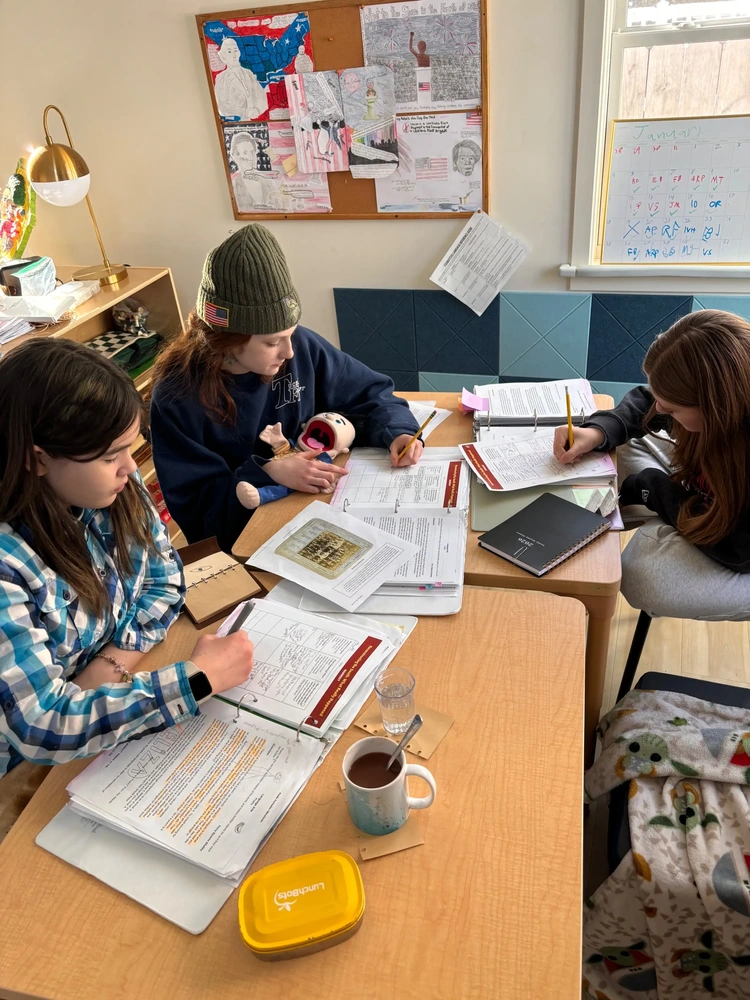
In practice, this means children are trusted with real choices, real materials, and real consequences. A Casa child selects their own work from the shelf, carries it to their chosen space, completes it, and returns it, without being told when to start, where to sit, or when they are finished. An elementary student plans their week, decides the sequence of their work, and is responsible for meeting their commitments. A junior high student navigates a long-term project from conception to completion, determining the resources needed, the timeline required, and the course corrections along the way.
The Montessori work cycle, a large block of uninterrupted morning work time, is the structural container that makes this possible. Rather than moving at the pace of a bell or the direction of a lesson plan, students develop their own rhythm of engagement; they learn to begin, sustain attention, manage transitions, and bring work to completion. Over time, this is not just a classroom skill. It becomes a habit of mind.
What is visible in these moments is not performance. It is practice, and practice, repeated across years, becomes character.
How Independence Builds From 16 Months Through 8th Grade
Autonomy in Montessori is not introduced at a certain age. It is present from the very beginning, calibrated carefully to match what each stage of development makes possible.
- Toddler (16–36 months): Independence begins with the body. Montessori practical life activities are designed to be completed by the child, from beginning to end, without adult assistance. A child of two pours water from a small pitcher into a glass; if they spill, they wipe it up. They put on their coat, wash their hands, care for a plant. These are not pretend tasks. They are real contributions to a real environment, and the child knows it. Dr. Montessori noted that when children are given work that is genuinely purposeful, they bring to it a concentration and seriousness that surprises most adults.
- Casa (3–6 years): Independence expands from physical self-care into intellectual self-direction. Children in the Casa choose their own work, manage the care of materials, and navigate social interactions with increasing confidence. A child might spend forty-five minutes with the long division bead frame, not because they are required to, but because they are not yet satisfied with their understanding. This capacity for sustained, self-directed attention is one of the most important things the Casa years develop.
- Elementary (6–12 years): The Montessori classroom in the elementary years is organized around collaborative independence. Students work in small groups, hold each other accountable, and pursue interdisciplinary projects that require planning, research, writing, and revision. A student who wants to understand why the Roman Empire fell will need to read, to ask questions, to organize their thinking, and to present what they’ve found, not because it is assigned, but because the question has become genuinely theirs. Independence here is intellectual as much as practical.
- Junior High (7th–8th grade): Autonomy becomes full self-authorship. Students in our junior high are expected to manage complex, long-term work, to reflect on their choices and their impact, and to take initiative in ways that extend beyond themselves. They plan their own occupational explorations, organize community service projects, and engage with the world outside the classroom as capable, responsible participants. They have practiced independence long enough that it no longer requires scaffolding. It simply is how they work.
The arc is clear: what begins as a toddler pouring water with focused attention becomes, thirteen years later, a young adult who knows how to identify a problem, think through it carefully, and move forward with purpose.
Frequently Asked Question: How Does Montessori Build Independence Without Losing Structure?Montessori independence is always developed within a prepared environment with clear expectations. Children have freedom of choice, but that choice is carefully bounded by the materials available, the community agreements in place, and the guide’s careful observation of each child’s readiness. Structure in Montessori is not imposed from the outside through rules and compliance; it is internalized over time through experience and trust. The result is children who regulate themselves, not because they are managed, but because they have genuinely developed the capacity to do so.
Independence Is Not the Same as Doing It Alone
One of the most important distinctions in Montessori education from toddler to middle school is this: independence does not mean isolation. It means the capacity to act with intention, to make choices with awareness, and to seek support when necessary, because knowing when and how to ask for help is itself a skill that must be practiced and developed.
In a Montessori classroom, children learn to work alongside one another with care and awareness. They collaborate without losing their individual thread. They ask a peer before they ask a guide; they attempt something before they declare they cannot do it; they sit with difficulty long enough to discover whether they can move through it. And when they genuinely need support, they have learned to ask for it clearly and without shame.
The guide plays a particular role in this. Montessori guides are trained observers, and their most important intervention is often restraint: knowing when not to step in, so that the child has the chance to experience their own capability. Dr. Montessori described the teacher’s role as that of someone who watches over the child’s spirit, present and attentive, but not intrusive. The child must be the author of their own discoveries.
This means that over time, children develop a relationship with challenge that is neither avoidant nor defeated. They have practice sitting with difficulty. They know that effort leads somewhere. And they know that when they genuinely need another person, asking is not a failure; it is wisdom.
We are all independent, but never alone. That is one of the deepest lessons a Sunny Hollow education offers.
What This Means for Your Child
A Sunny Hollow education gives your child something that cannot be taught directly; it can only be developed through experience, trust, and time.
Over the course of their years here, your child will:
- Learn to make real choices within a thoughtfully prepared environment, and to live with the consequences of those choices
- Develop focus and self-direction through the Montessori work cycle, building the capacity to initiate and sustain their own work
- Practice problem-solving as a daily habit, not an occasional challenge
- Build the confidence that comes from real experience, from having tried, struggled, adjusted, and succeeded, repeatedly and across years
- Learn to seek support with clarity and without shame, because genuine independence includes knowing one’s own limits
- Grow into leaders, not because they are told to lead, but because they have practiced it every day since they were two years old
What they carry out the door is not a set of skills, exactly. It is a way of being in the world: capable, purposeful, and grounded in a deep, unshakeable knowledge that they can figure things out.
Your child will know their own mind. And they will trust it.