

Where Every Child Gets to Learn and Lead
Step into a Montessori classroom and one of the first things you notice is not just what children are doing, but who they are doing it with.
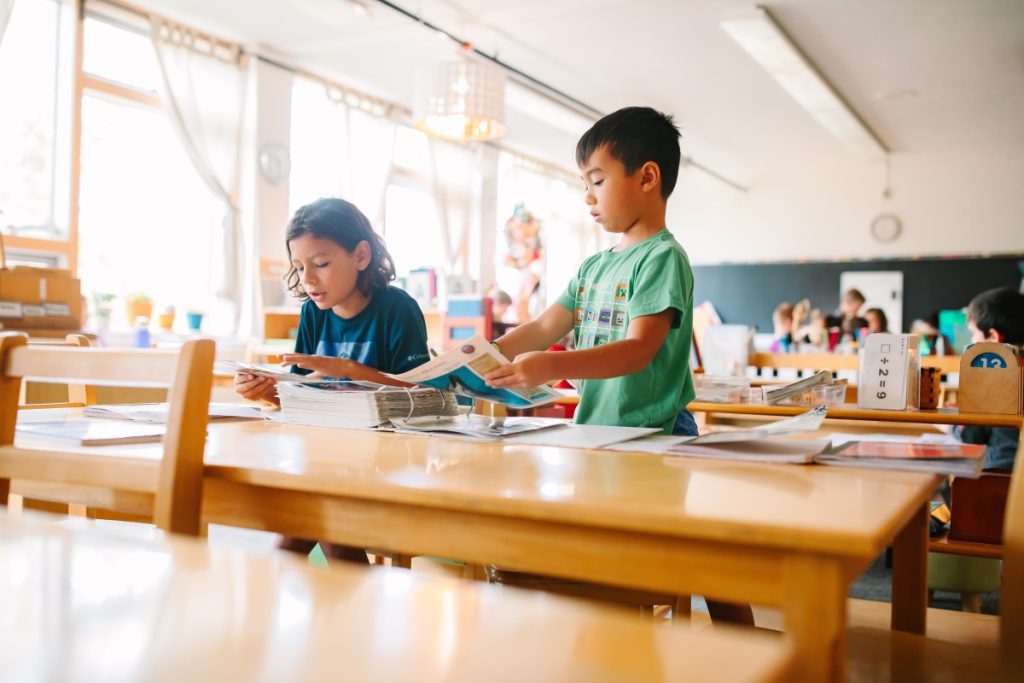
A younger child watches intently as an older peer completes a familiar piece of work, absorbing not just the technique but the attitude, the steadiness, the care. An older student pauses beside someone who is just beginning, offering quiet guidance with the ease of someone for whom this work became natural long ago. A group spanning ages, perspectives, and levels of experience works together with a shared sense of purpose that no adult has arranged or enforced.
This is not incidental. It is foundational.
Mixed-age classrooms Montessori programs are organized around are not a logistical compromise or a charming quirk of the methodology. They are a deliberate and precise educational design, grounded in Dr. Montessori’s careful observation of how children actually develop and how learning actually deepens. Rather than grouping children strictly by birth year, Montessori brings them together across developmental stages, creating a community that more closely reflects the way human beings have always learned: from one another, across age and experience, in communities where everyone has something to teach and everyone has something to learn.
Dr. Montessori observed this dynamic with characteristic precision: “The older child who teaches the younger one is not doing charity. They are consolidating knowledge they believed they had, discovering what they did not yet fully understand, and experiencing the particular satisfaction of contribution that no lesson from an adult can replicate.”
In this classroom, children are not only recipients of knowledge. Over time, they become contributors to it. And that shift, from learner to teacher and back again, is one of the most powerful things a Montessori education offers.
What Happens When Children Learn From Each Other
In a Montessori classroom, learning is not confined to the transmission of knowledge from adult to child. It flows continuously in multiple directions at once, through observation, imitation, mentorship, and the particular deepening that happens when you are asked to explain something you thought you already understood.
For younger children, the presence of older peers provides something no adult instruction can fully replicate: an accessible, aspirational model. A three-year-old watching a five-year-old work through the sandpaper letters is not simply observing a task. They are internalizing a sequence of action, a quality of concentration, and a relationship with the material that will shape their own approach when they are ready to attempt it. A first-year elementary student watching an older peer navigate a research process absorbs habits of mind, planning, persistence, revision, that would be difficult to convey through direct instruction and that land more naturally through the simple, powerful medium of watching someone their own age do the real thing.
This is the principle Dr. Montessori called indirect presentation: the younger child learns not only from what is directly taught to them but from everything happening in the prepared environment around them.
For older students, the dynamic offers something equally essential and equally irreplaceable: the experience of teaching. When a child explains a mathematical concept to a younger peer, demonstrates the use of a material, or supports someone in completing a task they themselves mastered months ago, they are required to do something that passive learning never demands. They must clarify their thinking, organize their knowledge, and respond to another person’s genuine confusion with patience and precision. In doing so, their understanding is not merely reinforced. It is discovered at a deeper level than they knew it existed.
Researchers call this the protégé effect. Montessori observed it a century before the research caught up, and she built it into the structure of every classroom she designed.
How the Mixed-Age Community Grows From 16 Months Through 8th Grade
The mixed-age structure takes a different form at each level of the program, calibrated to match the developmental characteristics of each stage. What remains constant is the fundamental dynamic: every child is always, simultaneously, someone who has something to learn and someone who has something to give.
- Toddler (16–36 months): Even within the relatively narrow age span of the toddler community, the presence of children at different points in their development creates a richly productive social environment. A child of thirty months who watches a slightly younger toddler struggling with a Montessori practical life activity and moves to offer a quiet, wordless demonstration is exercising social awareness and genuine generosity, capacities the adult can encourage but cannot produce through instruction alone. The younger child receives a model from someone whose size and developmental moment are close enough to make the demonstration feel not just instructive but possible.
- Casa (3–6 years): The three-year span of the Casa community is where the benefits of mixed-age classrooms Montessori education depends upon become most dramatically visible. The six-year-old who has spent three years in this environment moves through it with an ease and authority that every incoming three-year-old observes and absorbs. They know where things are, how they work, and what the community expects. They model this knowledge not through formal teaching but through the daily, visible fact of being themselves in a place they know completely. Mastery, in the Casa years, naturally and without adult orchestration, evolves into mentorship. And mentorship deepens mastery. The cycle is self-sustaining.
- Elementary (6–12 years): In the elementary years, the mixed-age model supports increasingly sophisticated intellectual collaboration. Students work together across the three-year span on research, problem-solving, and discussion, bringing varied knowledge and genuinely different perspectives to shared inquiries. The Montessori work cycle makes this collaboration possible by giving students the uninterrupted time to follow a shared question wherever it leads, without a bell pulling them in different directions before the thinking is done. Older students take on greater responsibility for guiding group work; younger students contribute the fresh questions and the unencumbered curiosity of someone who has not yet learned to take things for granted. Both contributions are real. Both are essential.
- Junior High (7th–8th grade): By the junior high years, the patterns established across a decade of mixed-age community life culminate in something that looks, from the outside, simply like maturity: leadership exercised naturally, accountability held genuinely, collaboration practiced with both honesty and care. Students manage complex work, support one another’s growth, and contribute to a community whose culture they have been building and inhabiting since they were toddlers. They do not have to be taught to lead. They have been practicing it, in one form or another, since the day they first became the older child in the room.
Across every stage, the progression is the same: observer, participant, leader. It is not assigned. It is lived, year by year, in the daily life of a community organized around the understanding that everyone has something to teach and everyone has something to learn.
Frequently Asked Question: Will My Child Be Held Back or Unchallenged in a Mixed-Age Montessori Classroom?
No. In a mixed-age Montessori classroom, every child works at the level of their own genuine readiness, not at the pace of the group. Because guides observe each child individually and offer lessons timed to each child’s developmental readiness, there is no ceiling imposed by grade level and no floor enforced by the need to keep everyone together. Advanced students are consistently challenged with more complex work; students who need more time with a concept have it without stigma. The mixed-age structure adds to this flexibility: children learn from peers across the age range, teach what thttps://sunnyhollow.org/wp-admin/media-upload.php?post_id=9882&type=image&TB_iframe=1hey know to those ready to receive it, and develop both academically and socially in ways that single-age grouping cannot support. Your child will be both supported and challenged, not despite the mixed-age structure, but because of it.
A More Human Model of Learning
Conventional schools organize children into single-age groups because it is administratively convenient and because it creates clear, uniform benchmarks. But they do not reflect the reality of how human beings actually learn, work, and live together.
In most real contexts, families, workplaces, communities, neighborhoods, people collaborate across age and experience. They learn from those who are further along. They support those who are just beginning. They occupy, sometimes simultaneously, the roles of student and teacher, novice and expert, the one who needs help and the one who offers it. The child who has spent their entire school career in single-age cohorts arrives in these real contexts without having practiced any of this. The Montessori graduate has been practicing it every day since they were three years old.
Montessori education from toddler to middle school mirrors this reality deliberately and consistently. The mixed-age classroom is not a simulation of the real world. It is, in its structure and its daily life, an early and genuine version of it, one in which the stakes are appropriate to childhood but the skills being practiced are the ones that matter for a lifetime.
Within this environment, Montessori independence and social responsibility develop together, each reinforcing the other. The child who has spent years learning to genuinely value the perspective of someone at a different stage than themselves, whether younger or older, is a child who is prepared, not just intellectually but habitually, to extend that same orientation outward into every community they will ever belong to.
Leadership here is not a title. It is not a reward for academic achievement or a role assigned by an adult who has decided a child is ready for it. It is a responsibility that emerges naturally from experience, from having been the youngest and having been the oldest, from having needed guidance and having offered it, from having understood, through the lived experience of years, that a community’s strength is not located in any single person but distributed across everyone within it.
What This Means for Your Child
A mixed-age Montessori classroom gives your child something that single-grade education, however excellent, cannot: the experience of belonging to a real community, with all the richness, complexity, and mutual accountability that real communities involve.
Over the course of their years at Sunny Hollow, your child will:
- Learn from peers as well as from guides, absorbing techniques, attitudes, and ways of working from children who are slightly ahead of them, in the natural and powerful way that observation of a near-peer always teaches
- Deepen their own understanding by teaching others, discovering through the act of explanation exactly where their knowledge is solid and where it needs more work, in a way that no review or assessment can replicate
- Inhabit each stage of development fully, spending two years as a newcomer and learner before moving into the elder role, without the pressure of being perpetually at the top of the age range or the anxiety of feeling perpetually behind
- Experience genuine leadership, in the final year of each three-year cycle, as the person whose competence and care visibly shape the experience of the younger children around them
- Arrive at high school having practiced, daily and across years, the collaboration, empathy, and cross-age community membership that most of their peers will be encountering for the first time
For younger children, this environment provides accessible models and a genuine sense of belonging within a community that is larger and more capable than they are yet, and that welcomes them anyway. For older students, it provides the particular satisfaction and the particular deepening that come from being someone others look to and learn from.
Your child will not just be supported here. They will learn to support others. And they will understand, in a way that becomes simply part of who they are, that learning is not a competition or a race. It is a shared journey, in which they are continually challenged, continually growing, and increasingly capable of helping the people around them do the same.
A Montessori classroom is not divided by age. It is united by purpose.
And your child, over time, will be one of the people who holds that purpose together.
Come watch a mixed-age community in action. It is one of those things that is immediately visible and immediately compelling when you see it in person.