

Freedom within Limits: A classroom where children choose their work—and rise to meet it
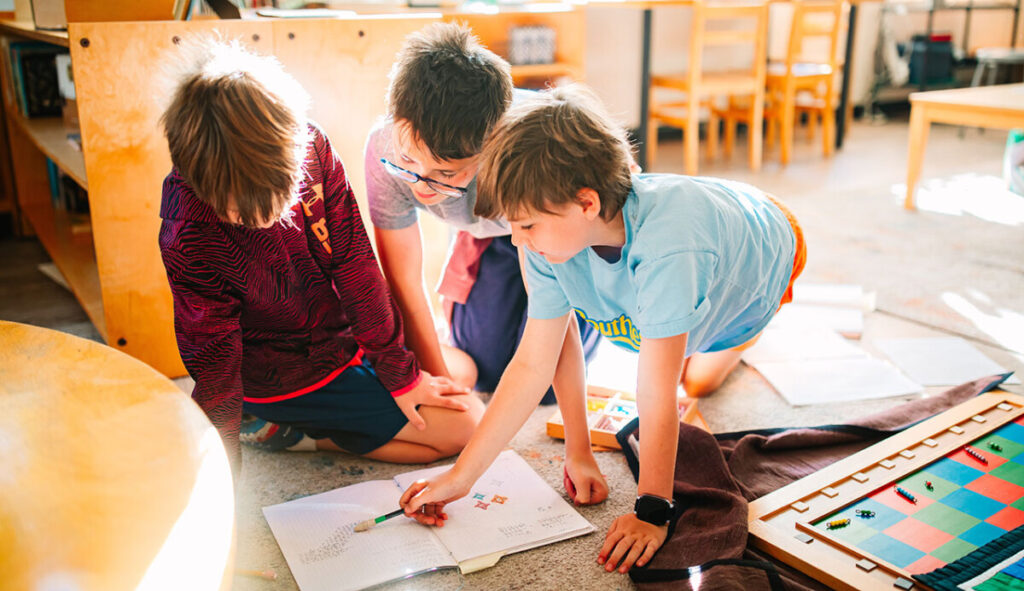
Walk into a Montessori classroom and you may notice something surprising. Children are not all doing the same thing.
- One child is tracing letters with quiet focus.
- Another is building a geometric form.
- A small group is gathered in discussion.
- A younger child carefully carries a tray across the room, fully absorbed in the task.
There is movement. There is choice. There is energy. And yet, it is calm. Ordered. Intentional.
This is often where misconceptions begin. Montessori is sometimes described as “free” or “unstructured.” This is the single most common misconception about Montessori education, and it is understandable. When you walk into a Montessori classroom for the first time and see children moving freely, choosing their own work, sitting on the floor, working at their own pace without a teacher at the front of the room directing everyone toward the same task, it can look, from the outside, like the absence of structure.
It is not. What you are seeing is something far more precise and far more demanding than conventional classroom management: freedom within limits. Children are given meaningful, genuine choice, but always within a carefully prepared environment, with clear expectations, consistent boundaries, and a community culture that every child has helped to build and every child is accountable to.
Dr. Montessori was emphatic on this point. “Discipline must come through liberty,” she wrote in her 1909 text The Montessori Method. But this does not mean that there is no discipline; it means that the child is given the space to develop their own discipline. This is the distinction that matters: not the absence of discipline, but its source. In a Montessori classroom, discipline is not imposed from the outside through rules and consequences. It is developed from the inside through experience, trust, and the gradual internalization of a community’s values.
We like to say that we put all the “Do it myself” to good use. Your young child will not be out of control here. They will learn self-control. And that is a genuinely different, and genuinely more lasting, thing.
Choice, Curated
In a Montessori classroom, children do indeed choose their work, but this choice exists within a carefully constructed framework that reflects both developmental knowledge and pedagogical intention. The range of what is available at any given moment corresponds to what the child is actually ready for, not what they might randomly gravitate toward if left entirely to their own devices. The guide has observed the child carefully, knows their readiness, and has prepared the environment accordingly. The choice is real and it is meaningful, but it exists within a framework that has been constructed by a trained adult who understands exactly what the child needs.
The classroom, then, is a carefully calculated environment, not a loosely arranged space in which children roam freely, but a designed experience in which every object on every shelf has been chosen for a specific developmental purpose and placed in a precise relationship to everything around it.
In practice, this looks different at each stage of development, but the principle is consistent across all of them.
In the toddler community, a child selects from a set of practical life activities, pouring, spooning, folding, caring for the environment, each designed to be completed independently from beginning to end. The choice is between purposeful options, not between purposeful work and something else entirely.
In Casa (ages 3 to 6), a child might independently choose to work with the sandpaper letters, tracing each form with their fingertip while hearing its sound, building early literacy through multiple sensory channels simultaneously. Or they might select the golden beads, working concretely with units, tens, hundreds, and thousands, constructing an embodied understanding of the decimal system long before encountering it in abstraction. Both are genuine choices. Both are also precisely the right work for where that child is developmentally.
As children mature, this curated choice evolves in both complexity and scope.
In Upper Elementary, a student might choose to pursue an extended research project, determining the topic, the sequence of inquiry, the materials needed, and the timeline for completion. Here, choice has expanded into full executive functioning: planning, prioritizing, and sustaining engagement across weeks of complex work. The freedom is real and substantial. So is the responsibility that comes with it.
At every level, freedom of choice is inseparable from accountability. Materials are handled with care. Work is carried through to completion. The needs of the community remain in constant view. The structure does not limit the child; it refines their capacity to choose well, and choosing well, practiced daily across years, becomes simply how they operate.
How Independence Builds From 16 Months Through 8th Grade
Independence in Montessori is not introduced as an abstract goal or a value the school happens to hold. It is built, carefully and consistently, through the specific experiences of each stage of development, each one preparing the ground for the next.
- Toddler (16–36 months): Independence begins with the body and the will. A toddler who pours water from a small pitcher, carries a tray across the room without spilling, wipes up the spill when they do, and returns the materials to the shelf has completed a full cycle of independent work. They initiated it, carried it out, managed the consequences, and finished it, entirely on their own. Dr. Montessori called this kind of activity “real work,” and she insisted on the distinction: not simulated tasks designed to keep children busy, but genuine contributions to a real environment that genuinely need doing. The child who wipes the table is not pretending to clean. They are cleaning, and the room is better for it, and they know it.
- Casa (3–6 years): Independence expands from physical self-care into intellectual and social self-direction. Children manage their own time within the Montessori work cycle, choose their own work, care for the materials and the environment, and navigate social interactions with increasing awareness and skill. The guide observes, introduces lessons at the moment of readiness, and steps back to allow the child the experience of figuring things out independently.
- Elementary (6–12 years): Independence becomes intellectual and collaborative. Students plan their work across longer periods, hold themselves and one another accountable within group projects, and take genuine ownership of their learning in ways that most students their age have never been asked to. A small group of third graders organizing their own project timeline is not a managed activity. It is a real exercise in planning, negotiation, and shared responsibility, and the students know the difference.
- Junior High (7th–8th grade): Independence is expressed as full autonomy and genuine self-authorship. Students manage complex, long-term work, engage in critical thinking about real-world problems, reflect seriously on their choices and their impact, and seek support when they need it, because knowing when to ask for help is itself a form of self-awareness that the Montessori years have been building toward. They are not performing independence. They have developed it, through practice, across thirteen years of being trusted with the real thing.
The throughline could not be clearer: what begins as a toddler pouring water with careful attention becomes, over time, a young adult who manages their own responsibilities with confidence, intention, and genuine ownership.
Frequently Asked Question: Does Montessori Have Rules? How Is Behavior Managed?
Yes, Montessori classrooms have clear expectations and consistent boundaries, but discipline is developed from within rather than imposed from without. Children learn that their freedom exists within a shared community, and that their choices carry implications not only for themselves but for everyone around them. Expectations around respect for oneself, for others, and for the materials are modeled consistently by guides and practiced daily by children. Rather than relying on rewards and consequences to manage behavior, Montessori environments support children in developing genuine self-regulation over time. The result is not compliance maintained by oversight, but internal discipline that holds its shape even when no one is watching.
Clear Boundaries Make Real Freedom Possible
Here is the part that surprises most parents who come to Montessori expecting permissiveness and find something else entirely.
The freedom children experience in a Montessori classroom is only possible because of the limits that surround and define it. Remove the limits, and you do not get more freedom. You get the aimless restlessness that is freedom’s opposite: children who have too many choices and no framework for making them, too much space and no sense of how to inhabit it, too little structure and, as a result, too little genuine independence.
The limits in a Montessori classroom are specific and consistently upheld. A child may choose their work, but their choice must not disrupt the concentration of others. They may move freely through the environment, but movement is guided by an awareness of space, purpose, and care. They may work independently, but independence does not mean isolation from accountability; it exists alongside responsibility to the work itself and to the broader community.
What distinguishes Montessori’s approach to limits is not their content but their purpose and their trajectory. In a conventional classroom, limits are imposed by the adult and maintained by the adult’s oversight. Remove the adult, and the limits often disappear with them. In a Montessori classroom, limits are introduced by the adult but gradually absorbed by the child, becoming part of their own decision-making process rather than an external constraint they are navigating around.
Dr. Montessori described this trajectory precisely: the child moves, over time, from obedience that depends on the will of another to obedience that depends on their own developed will. This is not a small distinction. A child who behaves well because someone is watching has learned compliance. A child who behaves well because they have genuinely internalized the values of the community has learned something that will serve them for the rest of their life.
At Sunny Hollow, we are building the second kind of child, not through enforcement or management, but through the sustained, patient, carefully structured experience of being trusted with real freedom and held to real expectations, every day, across the whole of their childhood.
What This Means for Your Child
A Montessori classroom is not unstructured. It is a calm, joyful environment, carefully designed to help children develop both genuine independence and genuine self-control, two things that are not in tension but that grow, in this environment, together.
Over the course of their years at Sunny Hollow, your child will:
- Learn to make real choices within a framework that refines rather than restricts their decision-making, developing the capacity to choose well as a daily practiced skill
- Build self-regulation from the inside out, moving gradually from expectations upheld by an adult to values genuinely held by themselves, because they understand why those values matter
- Develop focus, follow-through, and genuine accountability, through repeated experience of work that is chosen, carried through, and completed on their own terms
- Grow into independence that is grounded rather than performed, rooted in years of real experience rather than in the absence of adult direction
- Arrive at self-confidence that does not require an audience, the quiet, steady knowledge of someone who has been trusted with real freedom and has learned, through practice, to use it well
For younger children, this looks like a toddler who wipes up their own spill and returns the pitcher to the shelf without being asked. For older students, it looks like a junior high student who manages a complex research project, navigates a disagreement with a collaborator, and seeks support at precisely the right moment, because they know themselves well enough to know when they need it.
Your child will not just follow rules here. They will understand why rules exist, and they will make them their own.
That is not a small thing. That is the foundation of every form of genuine leadership, every meaningful relationship, and every contribution worth making to the world.
Come see freedom within limits in action. It is one of the most clarifying things a skeptical parent can do: observe a well-functioning Montessori classroom and watch the structure reveal itself, not in what is restricted, but in the purposefulness of everything that is happening.
Schedule a tour